
AI and Human Relationships: What We Lose When Technology Replaces Presence
Most conversations around artificial intelligence focus on jobs, productivity, and the future of work. But AI and human relationships deserve just as much attention. Technology is not only changing how people work. It is changing how they connect, how they listen, how they sit together, and how they emotionally show up for one another.
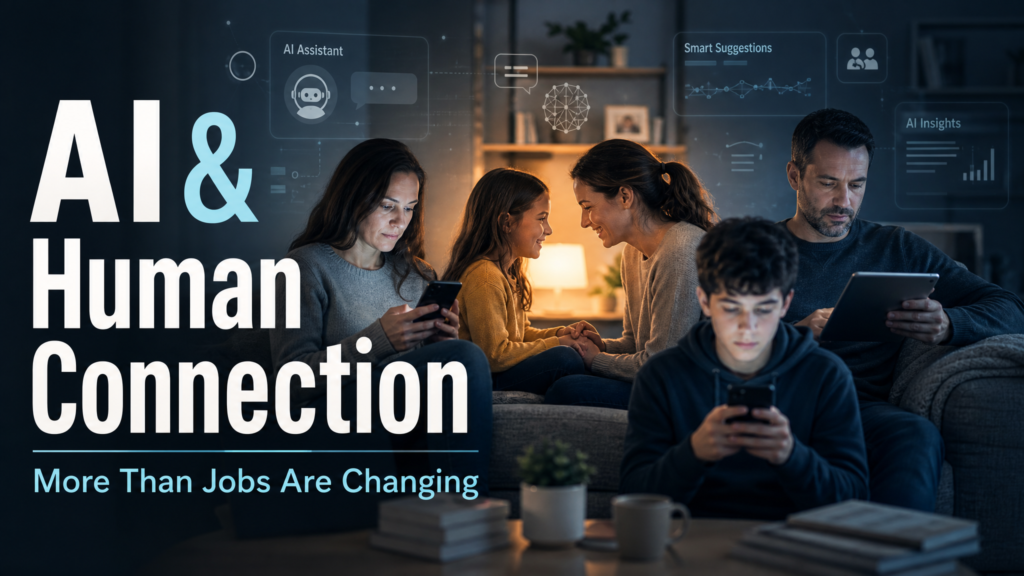
You can feel it in ordinary moments. A family sits in the same room, but everyone is somewhere else. One person is reading updates, another is watching short videos, and someone else is typing replies that cannot wait. Nobody is physically absent, but presence is missing. That is where the conversation about AI and human relationships becomes real. It stops being abstract and starts feeling personal.
The Convenience Is Real, but So Is the Distance
There is no doubt that AI can be useful. It helps people study faster, organize work, generate ideas, translate information, and solve problems in seconds. In many ways, it removes friction from daily life. That is exactly why it spread so quickly. The tools are fast, helpful, and often impressive.
But AI and human relationships are now colliding in subtle ways. The more convenient digital interaction becomes, the easier it is to replace deeper connection with efficient connection. People can send messages all day and still avoid real conversation. They can respond quickly without actually being emotionally available. They can stay in touch without staying close.
This is not about rejecting technology. It is about noticing the cost of using it without boundaries. AI and human relationships become strained when speed starts mattering more than sincerity.
Why Being “Connected” No Longer Means Feeling Close
Modern life makes it easy to confuse access with intimacy. You can reach someone instantly, but still not know how they are really doing. You can react to posts, like photos, send voice notes, and keep a streak alive while the actual relationship slowly becomes thinner.
That is one of the biggest concerns with AI and human relationships. The tools that promise connection can also train people to accept a lower quality version of it. A real conversation requires time, attention, and emotional patience. A screen-based habit often rewards the opposite: speed, distraction, and partial attention.
When that becomes normal, people stop noticing what is missing. They begin living around each other instead of with each other. That emotional gap can grow quietly for years.
AI Should Assist Human Life, Not Replace Human Warmth
The healthiest approach is not fear. It is balance. AI and human relationships do not have to be in conflict if people stay intentional. AI can help with tasks, planning, research, and efficiency. But it cannot replace eye contact, empathy, tone, laughter, physical presence, or the feeling of being genuinely heard.
There is a difference between being answered and being understood. There is a difference between digital interaction and emotional safety. There is a difference between convenience and care. Those differences matter more now than ever.
That is why people need to keep protecting spaces where no app gets to dominate the room. Dinner tables. Walks. Car rides. Living room conversations. Quiet moments with friends. Relationships deepen when people are not constantly split between each other and a screen.
What Stronger Human Connection Looks Like Now
- Putting phones away during real conversations.
- Choosing presence over multitasking when someone is opening up.
- Using AI for support, not as a replacement for emotional effort.
- Making time for unstructured connection with family and friends.
- Checking in deeply, not just frequently.
The future of AI and human relationships will depend on choices people make every day. Not dramatic choices. Simple ones. Whether you look up when somebody talks. Whether you keep your phone down for ten minutes. Whether you let convenience slowly train you out of intimacy.
The Real Question Is Not What AI Can Do
The real question is what kind of human life people want to protect while AI keeps expanding. If the answer includes closeness, trust, emotional depth, and family connection, then AI and human relationships need to be handled with more care than most people are giving them right now.
At Contact Mee, we believe technology should make life better without making relationships thinner. If this article gave you something to think about, stay connected with us for more thoughtful reads on modern life, emotional well-being, and digital balance.