
Can Simulations Cheat Physics? Why Physics Simulations Can Look Real and Still Be Wrong
We live in a world where digital models shape how we understand weather, climate, engineering, traffic, ocean systems, and even future risk. That is why physics simulations matter so much. They are not just pretty moving graphics on a screen. They influence research, planning, design, and decisions that affect real people. But here is the uncomfortable truth: a simulation can look smooth, detailed, and convincing while still being deeply wrong.
That is the central idea behind this topic. Good visuals do not automatically mean good science. In physics simulations, accuracy is not only about appearance. It is about whether the model respects the rules that govern the real world. If it ignores those rules, it can drift away from reality even while looking impressive to the human eye. And once that happens, what seems trustworthy may actually be misleading.
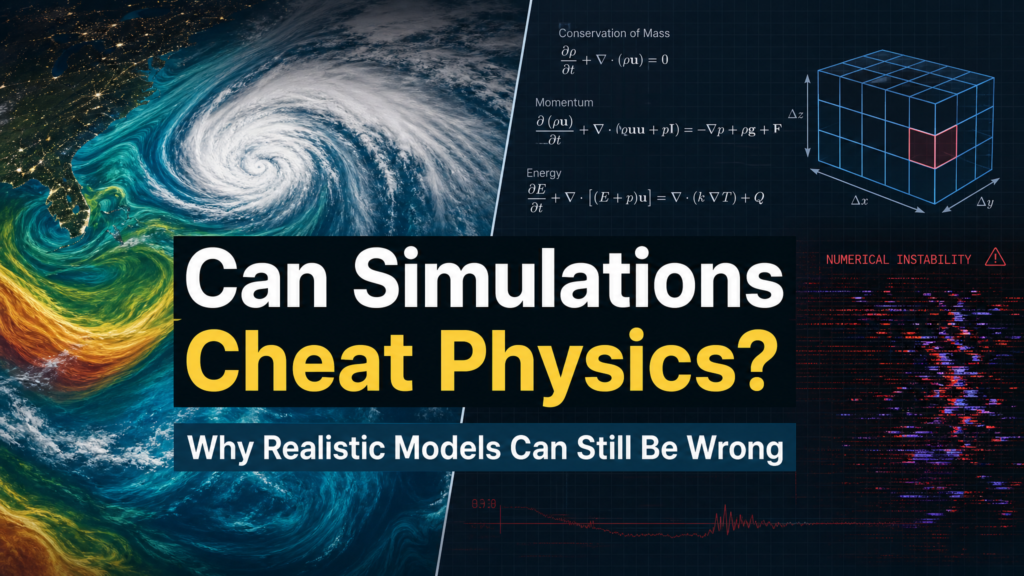
Why Physics Simulations Need More Than Realistic Visuals
At their core, physics simulations are mathematical approximations running on computers. Scientists take equations that describe motion, heat, fluid flow, energy transfer, or wave behavior, then break those equations into small numerical steps. That process makes the problem computable. But it also introduces risk. The moment a continuous physical system is turned into a grid of points and time steps, something subtle can go wrong. The computer may still produce an answer, but the answer may no longer preserve the structure of the original physics.
That is where many people misunderstand how models work. If a simulated ocean looks like an ocean, or a digital weather field looks like a weather map, people assume the system must be behaving correctly. But strong-looking visuals can hide weak foundations. In real science, a simulation has to do more than resemble reality. It has to follow physical laws in a stable and consistent way. That is the difference between eye-catching graphics and truly reliable physics simulations.
What Goes Wrong When the Rules Are Broken
When a model stops respecting physical laws, the errors are not always dramatic at the beginning. They can start small. A system may gain a little extra energy that should not be there. A wave may move at the wrong speed. A quantity that should stay conserved may slowly leak away. At first glance, everything may still look fine. But over time, those tiny mistakes build on each other. That is when physics simulations begin to separate from the reality they are supposed to represent.
This is especially important in systems that are already sensitive, such as turbulence, weather, or fluid motion. In those settings, a small numerical issue can grow into a major distortion. A model that does not preserve the right structure may tell a convincing story for the first few steps, then quietly move into a world that no longer matches the real one. The danger is not just that it becomes less precise. The danger is that it becomes confidently wrong.
- Mass can stop being conserved.
- Energy can be added artificially.
- Signal speeds can become unrealistic.
- Stability can break down over time.
- Long-term forecasts can drift far from reality.
Why Stability Matters So Much
One of the biggest lessons in computational science is that stability is not a technical side note. It is the backbone of trustworthy modeling. Many physics simulations depend on the relationship between how fast information moves, how far apart grid points are, and how large each time step is. If the time step is too large compared with the grid and the speed of the system, the model can stop tracking motion correctly. It begins skipping over the very information it is supposed to capture.
A simple way to imagine this is to think about filming a race car with a slow camera. If the car moves too far between frames, you lose the path. The motion becomes broken and confusing. That same logic shows up in numerical modeling. If information travels farther than the grid can properly resolve in one step, the simulation can become unstable. In other words, physics simulations do not just need equations. They need careful numerical discipline that respects how the system actually evolves.
Why Conservation Laws Are Non-Negotiable
Real physical systems are governed by principles that do not disappear just because we moved from paper to code. Conservation of mass, conservation of momentum, and conservation of energy are not decorative ideas. They are part of the architecture of reality. That is why well-designed physics simulations must protect those structures instead of accidentally breaking them during approximation.
If a pendulum gains energy for no physical reason, something is wrong. If waves grow for no reason, something is wrong. If a fluid model slowly invents or loses the amount of matter inside it, something is wrong. These are not cosmetic issues. They change the behavior of the whole system. Once a model starts violating its own physical backbone, the outputs may still be colorful and detailed, but they stop being dependable.
What This Means for AI and Modern Models
This conversation becomes even more important when artificial intelligence enters the picture. AI systems are extremely good at spotting patterns in data. They can imitate outputs, learn trends, and generate forecasts that look impressive in the short term. But unless physical structure is built into the model, AI does not automatically understand the laws of nature. That means AI can produce outputs that look believable without having the physical integrity required for dependable physics simulations.
That is why many researchers are moving toward hybrid approaches. Instead of choosing between raw machine learning and classical equations, they combine data-driven methods with physics-aware design. This is where the future gets exciting. The best systems may be the ones that learn from data while still honoring conservation, causality, signal speed, and stability. In that world, physics simulations become both more flexible and more trustworthy.
Why This Topic Matters Beyond Science Class
This is not only an issue for mathematicians or engineers. The public depends on models all the time, often without realizing it. Storm forecasting, flood planning, aviation safety, climate risk, and infrastructure design all rely on the quality of underlying physics simulations. If those models are stable and physically grounded, they can help people make smarter decisions. If they are built carelessly, the consequences can ripple outward in ways that affect policy, business, and public trust.
There is also a bigger mindset lesson here. In the digital age, appearance can be persuasive. A sharp interface, a smooth animation, and a compelling output can make almost anything feel authoritative. But this topic reminds us that strong presentation is not the same as strong foundations. The same principle applies far beyond science. Whether we are looking at models, media, data dashboards, or AI tools, we should ask a deeper question: is this system grounded in something real, or does it only look convincing?
The Smarter Way to Think About Trustworthy Models
If there is one lesson worth keeping, it is this: realistic outputs are not enough. The goal of physics simulations is not to create something that merely resembles reality for a moment. The goal is to reproduce the way reality behaves over time. That means respecting physical laws, protecting stability, and building models that do not break the system they claim to represent.
That is why this topic feels so timely. As digital tools become faster and more visually impressive, the real competitive edge may belong to models that stay honest under pressure. The most valuable simulation is not the prettiest one. It is the one that still makes sense when the math, the physics, and the long-term behavior are all put to the test. In the end, the future of physics simulations belongs to systems that earn trust instead of merely borrowing it.
Watch the Video Inside This Post
More From Contact Mee
If you enjoy thoughtful explainers, smart trends, and human-friendly deep dives, keep exploring more with Contact Mee.